WTI struggles at $75.00, slides half percent on broad US Dollar strength
- Western Texas Intermediate printed a three-month high at $76.65.
- Developing energy crises in the UK and Europe could keep oil prices higher.
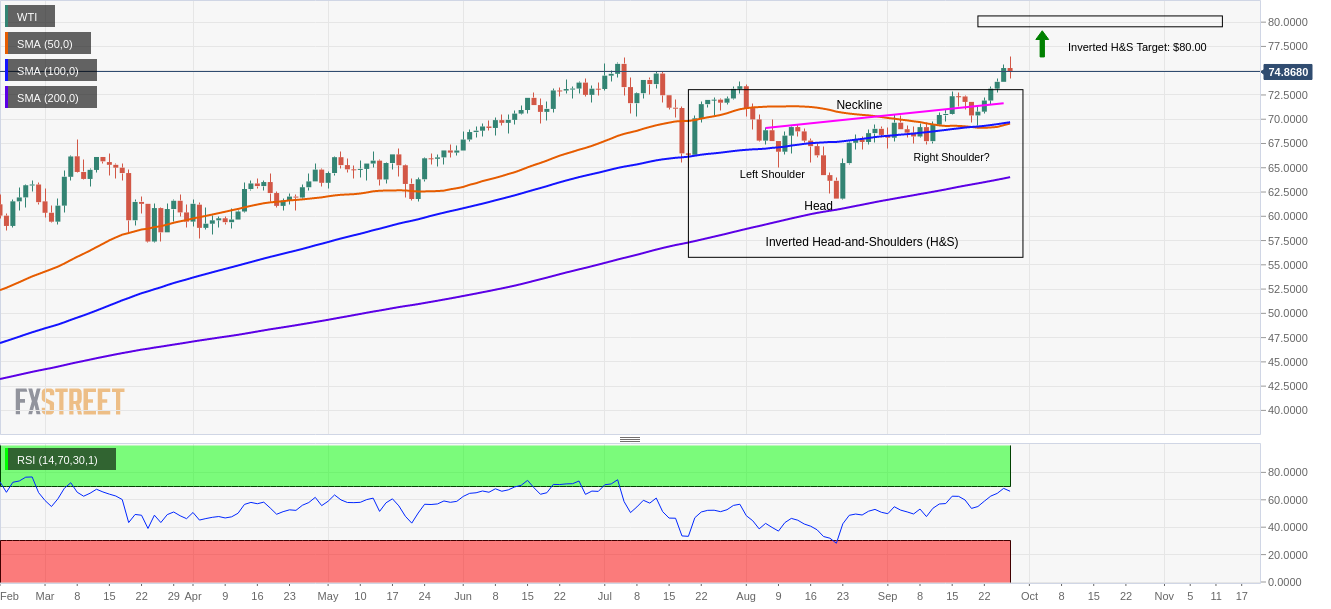
- From a technical perspective, WTI upward bias remains unchanged.
WTI fell from a three-month-high around $76.65 during the New York session. At the time of writing is trading at $74.90, losing 0.50% amid downbeat market sentiment. The US Dollar Index (DXY), which tracks the buck’s performance against six rivals, is up 0.40%, sitting at 93.79, weighing on the Western Texas Intermediate (WTI) price.
Worldwide energy crunch crisis, boosted oil prices
During the European session, Oil prices rallied above $76.00 in the prospects of an energy crisis in the UK and Europe.
In the UK, Prime Minister Boris Johnson put the army on standby to help deliver supplies to gasoline stations. The Petrol Retailers Association said that some of its members in England have all run out of fuel. British companies said they expect demand to ease in the coming days, as there’s enough fuel at refineries and terminals.
Meanwhile, the UK and Ditch front-month natural gas contract rose 12% in early trade in Europe before trimming some losses. Surging energy prices are going to be discussed by European leaders when they meet for a summit on October 21 -22.
WTI Price Forecast: Technical outlook
Daily chart
WTI is trading above the neckline of an inverted head-and-shoulders pattern. During the day, tested the July 6 high at $76.40; nevertheless, the price retreated. Failure to close above $75.00 could expose the July 30 high at $73.88 as the first support level. A break beneath that level could push WTI towards $73.00, followed by the September 15 high at $72.88.
On the flip side, a daily close above $75.00 could give WTI’s bulls a breather in their attempt to resume the upward bias towards the Inverse head-and-shoulders target of $80.00.
The Relative Strength Index is at 66, slightly down, suggesting that oil prices could consolidate in the short term.